South Korea's AI Basic Act: Why Global Companies Are Paying Attention
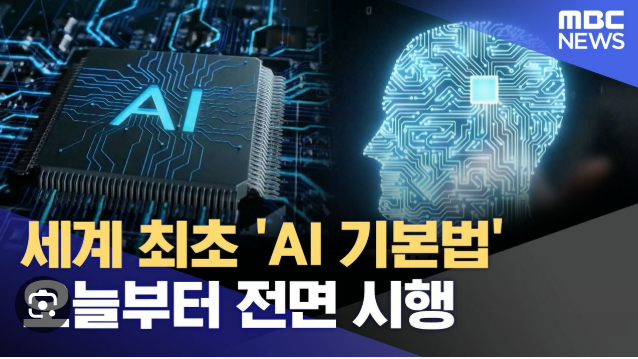
In 2025, South Korea adopted the most wide-ranging legislation impacting artificial intelligence after the European Union's AI Act. This legislation, known as the Act on the Development of Artificial Intelligence and Establishment of Trust, or the AI Basic Act, represents only the second comprehensive AI regulation globally. What makes it particularly noteworthy is that while the EU crafted its legislation first, South Korea has moved faster on implementation. The Korean law took effect on January 22, 2026, while the EU's high-risk AI regulations won't fully apply until December 2027.
The global business community is watching Korea's approach closely, not just because of the timeline, but because of how the law works in practice. Unlike the EU's AI Act, which imposes different obligations on AI actors based on their specific roles in the supply chain, Korea's AI Basic Act takes a more straightforward approach by applying uniform standards to all AI business operators. This creates a more predictable regulatory environment, particularly valuable for multinational companies evaluating their compliance obligations across different markets.
Another factor driving attention is Korea's position as one of the world's most digitalized economies with exceptionally high AI adoption rates. Success in navigating Korea's regulatory framework can position companies favorably for expansion into other Asian markets, making the AI Basic Act more than just national legislation but potentially a template for the Asia-Pacific region.
Understanding the Scope of Application
The AI Basic Act applies to all business operators, a term that encompasses corporations, organizations, individuals, and government agencies conducting business related to the AI industry. These operators fall into two categories: AI Development Business Operators, who develop and provide AI systems, and AI Utilization Business Operators, who provide products or services using AI. A limited exception exists for operators developing or using AI solely for national defense or security purposes.
The extraterritorial reach of this law deserves particular emphasis. Any business operator without a domestic address or place of business in South Korea must designate a domestic agent in writing if their AI system has an impact on the domestic market or users. This domestic agent assumes responsibility for risk management reporting, confirming whether high-impact AI is involved, and implementing safety and reliability measures. For global companies offering AI services in Korea, this domestic agent requirement is not merely administrative but represents a substantive compliance obligation.
High-Impact AI and Core Requirements
Korea's AI Basic Act adopts a risk-based regulatory approach centered on human rights and responsible AI use. The law focuses on high-impact AI systems, defined as those having significant impact on or posing risk to human life, physical safety, and fundamental rights. Specific high-risk categories are explicitly identified, including biometric data for criminal investigations, hiring processes, loan screening, healthcare, nuclear material management, and drinking water production.
Business operators developing or using high-impact AI in South Korea must comply with several mandatory requirements. First, they must notify users in advance that the product or service operates based on artificial intelligence, along with other disclosure requirements. Second, they must implement risk management and user protection measures across the entire AI lifecycle, including monitoring for and responding to AI-related safety incidents.
Third, operators must confirm through review that a high-impact AI system is in use. Fourth, they must implement specific measures to manage risks when high-impact AI systems are deployed. Fifth, they must meet explanation and documentation requirements that identify how results were derived, the main criteria used to derive those results, and an overview of the training data used to develop the AI system.
Sixth, they must implement human management and supervision of high-impact AI systems. Finally, they must perform impact assessments covering effects on fundamental rights. These requirements impose substantial legal obligations on AI operators but simultaneously aim to build user trust and market stability through transparency and accountability.
Enforcement Framework and Penalty Grace Period
The AI Basic Act established the National Artificial Intelligence Committee, which makes recommendations to government agencies and decides major policy-related issues concerning AI. Beyond this committee, the Minister of Science and Information and Communication Technology enforces the law. The Minister can conduct investigations and impose fines on business operators who fail to comply with notification requirements, fail to designate a domestic agent, or fail to comply with suspension or correction orders. Fines can reach up to 30 million won.
However, recognizing that companies need time to adapt, the government has granted a grace period of at least one year before imposing penalties. During this guidance period, fact-finding investigations will only be conducted in cases involving serious issues such as casualties or human rights violations. This pragmatic approach provides businesses with breathing room to establish compliance systems while the legal framework is already operational.
The government has also opened an AI Basic Act support desk providing expert consulting and is conducting on-site briefings for startups. Companies should view this grace period not as a delay in compliance obligations but as a valuable opportunity to build robust systems before enforcement begins in earnest.
Why Korea's Approach Stands Out from the EU Model
Global enterprises are focusing on Korea's AI Basic Act for several distinct reasons beyond just regulatory novelty. The clarity and enforceability of the Korean framework contrasts sharply with the EU approach. The EU's AI Act, spanning hundreds of pages with complex provisions, imposes different obligations at each stage of the AI supply chain, making it challenging for companies to accurately determine their role and compliance requirements.
Korea's approach of applying uniform standards to all operators while concentrating on high-impact AI enhances regulatory efficiency. More importantly, the implementation timeline gives Korea a first-mover advantage. While the EU enacted its AI Act in 2024, full application of high-risk AI regulations is staggered until December 2027. Korea, having implemented its law in January 2026, has effectively become the first jurisdiction with comprehensive AI regulation in full operation, making it a real-world testing ground for AI governance.
Korea's position as a highly digitalized economy with rapid AI adoption means that regulatory patterns established here could influence broader regional standards. Companies that successfully navigate Korean compliance may find themselves better positioned for other Asian markets where similar frameworks may emerge.
Practical Preparation for Compliance
Companies offering AI products or services in the Korean market should take concrete steps immediately. First, determine whether your AI systems qualify as high-impact AI under the statutory categories. This assessment requires careful analysis of how the system affects human life, physical safety, and fundamental rights.
Second, if your systems qualify as high-impact AI, build internal processes capable of meeting all requirements outlined above. This includes developing notification procedures, risk management protocols throughout the AI lifecycle, documentation systems for explainability, human oversight mechanisms, and impact assessment capabilities. These are not superficial compliance exercises but require substantive operational changes.
Third, if domestic agent designation is necessary, engage trusted legal partners to appoint an appropriate representative. The domestic agent role carries real responsibilities and potential liability, so this decision should not be taken lightly. Companies operating in hiring, loan screening, or healthcare sectors should exercise particular care, as these areas are explicitly included in high-risk categories and face enhanced compliance obligations.
Technical documentation work to ensure AI system transparency and explainability should proceed in parallel with legal compliance. The explanation requirements demand that companies be able to articulate how their systems derive results, what criteria they use, and what training data underlies their models. For many AI systems, particularly those using complex machine learning, this may require significant technical work to achieve genuine explainability rather than superficial descriptions.
Looking Ahead
Korea's AI Basic Act represents significant legislation establishing a legal framework for the AI era. By adopting a clearer and more practical approach than the EU's AI Act while moving faster on implementation, it provides multinational companies with a more predictable legal environment when entering the Korean market. The approach of concentrating on high-impact AI while applying uniform standards to all operators achieves a balanced methodology that promotes both regulatory efficiency and fairness.
As AI technology rapidly evolves, related regulations will continue to develop. For companies planning to enter the Korean market or already providing AI services there, AI Basic Act compliance is not optional but essential. Domestic agent designation, high-impact AI determination, and risk management system establishment are areas difficult to implement properly without professional legal guidance.
The current one-year penalty grace period represents a valuable opportunity for companies. Using this period to complete compliance systems and meet the transparency and safety standards the law requires will be critical for stable business operations beyond 2027. Companies should view this not as a postponement but as a window for building sustainable compliance infrastructure.
For companies needing guidance on Korean AI Basic Act compliance, contract review, or establishing compliance frameworks, LexSoy is ready to assist. Please contact us at contact@lexsoy.com for professional legal consultation on AI regulatory matters.
© LexSoy Legal LLC. All rights reserved.